GSG Impact Summit 2027
2nd March 2027 | 09:00 CET | The Hague, the Netherlands



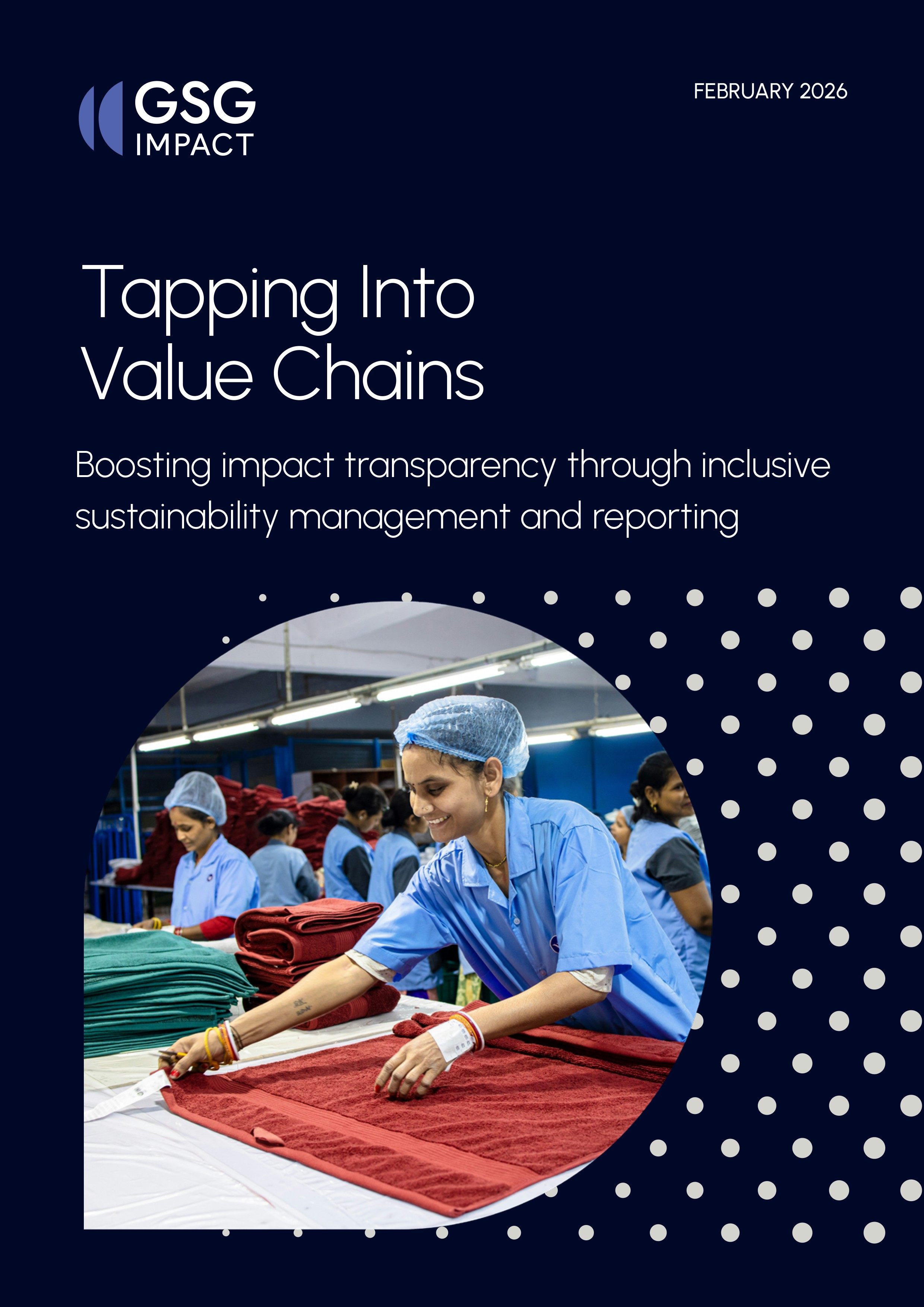
Tapping Into Value Chains
Boosting impact transparency through inclusive sustainability management and reporting
Sustainability management and reporting, understood as the processes by which companies identify, measure, monitor, and disclose their material environmental, social, and governance risks, opportunities, and impacts, has become increasingly essential to how businesses build competitiveness, resilience, and trust in today’s economy. At the same time, sustainability management and reporting are a critical foundation for system-level impact transparency, particularly when adopted consistently across value chains. Yet for most small and medium enterprises (SMEs)—especially in emerging markets and developing economies (EMDEs)—the business case remains unclear, and the pathway to implementation often feels out of reach. Limited resources, capacity and technical know-how, combined with emerging sustainability-related reporting requirements designed primarily for large corporations, make it difficult for SMEs to engage meaningfully.
Against this backdrop, corporations have become pivotal actors in advancing sustainability management and reporting across value chains. While global regulatory momentum is shifting—with slowdowns in parts of the US and Europe—investors and corporations continue to demand reliable sustainability information. As these expectations cascade through supply chains, SMEs increasingly must demonstrate credible sustainability performance to remain competitive, meet buyer requirements, and access capital - contributing to greater impact transparency across markets.
GSG Impact, through its partnership across 48 countries, is working to highlight the role of corporations and their unique position to drive impact transparency by enabling more inclusive, practical sustainability management and reporting across value chains. This document—informed by 200+ stakeholders across Nigeria, Brazil, Thailand and Malaysia—intentionally focuses on market-driven approaches emerging from businesses themselves, rather than from regulation or standard setters alone.
Fostering sustainability through business activity does not reduce the importance of collective action. While corporations are central to accelerating progress, governments, investors, standard setters, business associations, and SMEs each have critical roles to play.
Only through coordinated action can sustainability management, reporting, and impact transparency scale globally and equitably. Our findings show that real progress depends on holistic solutions combining: 1) incentives, 2) capacity building, 3) data and technology systems, and 4) partnerships for innovation. When approached and designed together, these solutions reinforce one another, enabling both corporations and SMEs to create tangible value—driving efficiency, competitiveness and positive impact across value chains.
Sustainability management and reporting are no longer optional—they are a foundational enabler of impact transparency, which in turn underpins resilient, forward looking, and impact-driven economies. The opportunity ahead is to ensure that these systems work for all, with SMEs being empowered to innovate and prosper, and where every business decision contributes to enduring value for people and planet.
Since the establishment of the Impact Taskforce (ITF) in 2021, under the auspices of the UK G7 Presidency, in our landmark Time to Deliver report we called for systemic change in investment decision-making to ensure that impact is taken into account in every business and investment decision as a “third lens” alongside risk and return, to accelerate
the volume and effectiveness of private capital seeking to have a positive social and environmental impact.
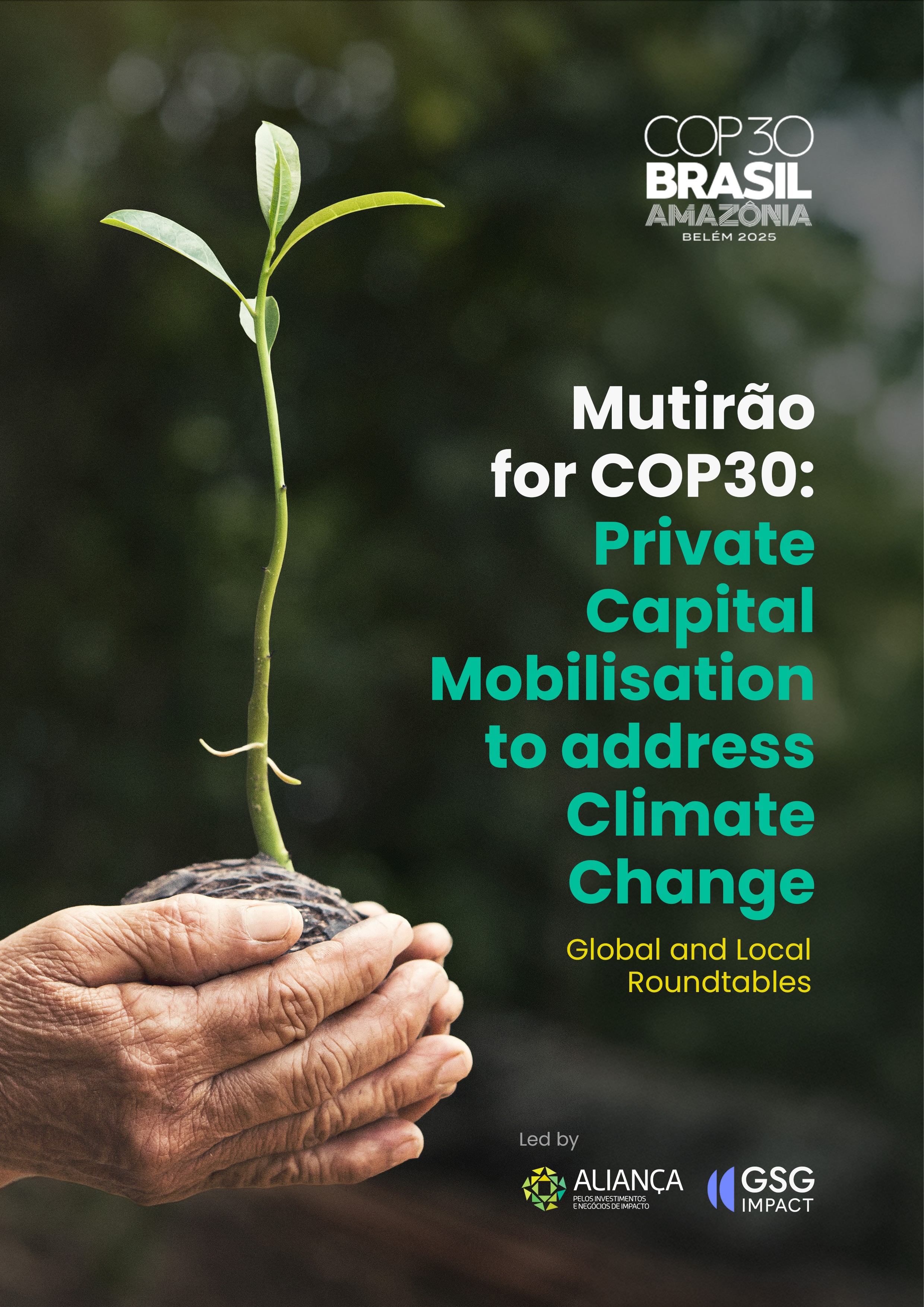
In the lead-up to COP30 in Brazil, GSG Impact, Aliança pelo Impacto and the Principles for Responsible Investment convened asset managers, asset owners, development banks, and policymakers to identify critical barriers and breakthrough actions needed to scale emerging market investment in climate change mitigation, nature-based solutions, and climate adaptation and resilience. This report synthesises the main takeaways across the global and local roundtables: the importance of regulations and taxonomies harmonization, the central role of blended finance and risk mitigation instruments, and the need for national and subnational project aggregation platforms.
Cómo los gobiernos de América Latina pueden impulsar el desarrollo sostenible a través de la Economía de Impacto. En este artículo, el colectivo GSG LATAM explora cómo los gobiernos pueden impulsar las economías de impacto a través de la política pública y comparte ejemplos que ya están transformando el panorama en América Latina. El documento se apoya en el reporte “Towards Impact Economies: Aligning Government Action and Private Capital for Public Good: A Policymaker’s Toolkit”, de GSG Impact.


No Content Set
Exception:
Website.Models.ViewModels.Blocks.SiteBlocks.CookiePolicySiteBlockVm